Tuesday, February 24, 2015

Messing-Up-To-Learn

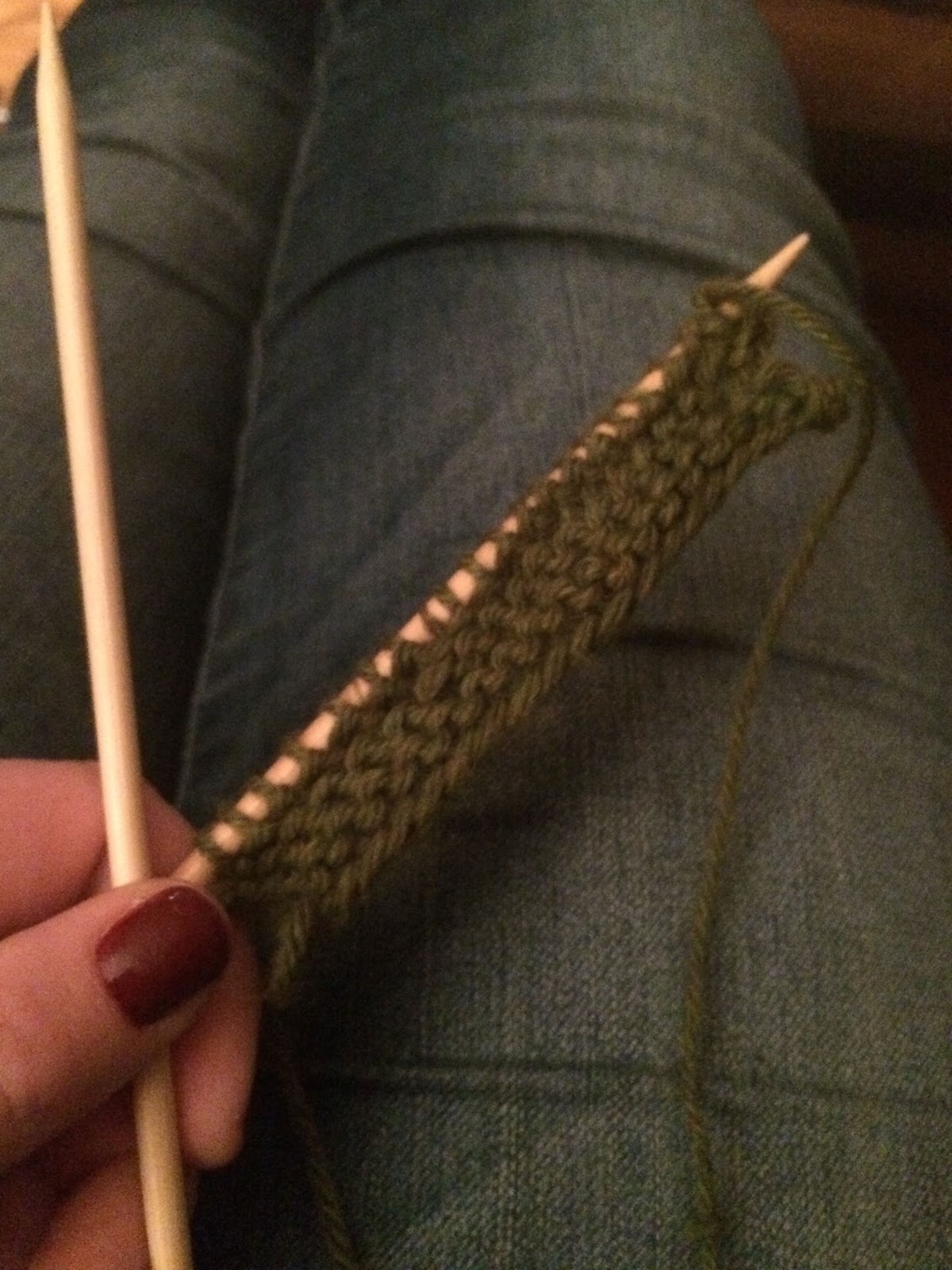
The first time I tried to knit an entire scarf I messed up. Quite comically. Fortunately, my mistakes helped me to learn.


Here’s what happened:


One of the first steps of knitting is to learn how to cast stitches onto the needle. It took me more than a few tries to learn to cast on, but eventually I got it. 

“Awesome!” I thought to myself, “FINALLY. I've got it!”. 

In the midst of my excitement, I got slightly ahead of myself and cast approximately thirty-five stitches onto a tiny needle.


Mistake Number 1.


Be sure to find a good estimation of how many stitches to cast on before you begin.


I did not realize that the knit stitches would  “grow” as I knitted along the needle. Soon after casting on so many stitches, I observed that the knitting became very difficult. It seemed that the needles were overloaded by WAY too many stitches. I thought about this for maybe a moment, but continued to knit away, revelling in the observation that I was actually knitting. Or so it seemed...


Mistake Number 2.


If something seems off about your project...Stop. Look at your stitches and ask yourself, "Does this look right?". Keep in mind that you (or a friend) are probably planning to wear the finished project.


I continued with the scarf, and I began to have a hard time transferring stitches from one needle to the other. As I mentioned before, I was knitting too tightly and too closely to the top of the needles, which caused the stitches to catch on the ends of the needles.


Mistake Number 3.


Remember to knit your stitches below the top of the needle. If you knit too closely to the top of the needle, where the point is, the knots will be too small. The top of the needle is smaller than the mid-shaft section of the needle. I made the mistake of knitting too close to the top and ended up with knitted stitches that were far too small in diameter. When I tried to move the stitches down the needle, they got stuck.

As I sat there, looking at my mistakes, I tried to figure out how they had happened and why the knots looked strange. I could see that my work had gotten slightly better as I progressed through rows. I started to pull out some of the stitches, working back to a row that made more sense. In such reflection, I began to understand how I might fix the mistakes.


As you can imagine, the scarf I produced from this naive knitting project was not much of a scarf at all. Instead, it was a collection of different sized stitches with little bits of wool sticking out. By the time I got to the end of the skein, I had a project I was not happy with. It was not pretty, or cute, or trendy. It was just...well...a mess. Nevertheless, I have found these mistakes to be invaluable to my progress as a knitter.


One key benefit to the “unknitting” practice has been the development of the ability to differentiate knits from purls. I learned more about the structure of the knot as I "unknitted" and "unpurled" Additionally, I have found the process of remaking a piece to be quite rewarding, for the advancement in skill level the second time around is both observable and tangible.  


These observations, along with previous research, lead us to question the role of mistakes in education, and further, the cognitive benefits of “messing up”.


The importance of mistake-making is often present in conversation about the learning process. In this blog post, New York Times journalist Alina Tugend discusses the role error making in school classrooms, arguing that students can benefit from embracing such mistakes. If students are afraid of mistakes,” she writes, “then they're afraid of trying something new, of being creative, of thinking in a different way.”  Tugend grounds her ideas in the empirical work of Dr. Carol Dweck, a professor of psychology at Stanford University. Results from Dweck’s research suggest that student mindset is tied to the acceptance of mistake-making as part of the learning process.


This work is motivating, for it seems that if I am open to inevitable mistakes and the learning that can result from subsequent correction, it is likely that errors will have a positive function in my learning process.

Tuesday, February 17, 2015

CNN: This is your brain on crafting

A few weeks ago, I came across this CNN story while reading the news. The reporters explore the potential therapeutic, meditative, and neurological benefits of knitting. As I have become more familiar with knitting techniques and the rhythm of the movements, I have started to find a comfort in the practice. I like to sit and knit as I am talking to others or listening to a podcast. In fact, every now and then, I start to feel a bit antsy if my hands are still. I am not sure if anyone has noticed, but sometimes I bring my yarn and needles to class, and knit while the professor lectures (the ball of yarn hides in my backpack, while a trail of working yarn leads to my desk). 

It seems, at least for me, that knitting can have a calming role in daily life.


Monday, February 9, 2015

Knitting: Not just for grandmas

After talking with friends, I have observed an interesting dichotomy in the college gal’s conceptualization of knitting: The more artsy ladies seem to find interest in knitting and various fiber arts, but others seem to think that knitting is “something grandmas do.” I have spent some time trying to think through why this might be. Perhaps the college-aged woman thinks knitting is a hobby for older people because she learned from an older person. In fact, many of the women I have spoken with know how to knit only because their grandmothers taught them.


While it may be the case that older family members are responsible for the continuation of fiber arts practices in younger generations, it seems as if recent developments in maker culture have led to a resurgence in the crafting domain.


In a BBC News article, wire artist Charmione Lloyd states that “knitting is going through a sort of renaissance”. She says that evidence for such revival can be found in the growing number of knitting groups--so-called crafting circles--that have begun to pop up in communities worldwide.


A couple of years ago, Tom Ashbrook, a radio DJ in Boston, dedicated a radio session to knitting’s comeback in the 21st century. On Point, the name of Ashbrook’s radio show, aired a piece titled “The Resurgence Of Knitting”, which featured several north-eastern knitters who are young fiber art enthusiasts. Listen to the full piece here.


In the following weeks, I will dig deeper into the idea that knitting is an art for all ages (not just  grandmas).

Tuesday, February 3, 2015

First Knits

It’s easy to see why fiber arts are appealing: You get to use soft materials, your crafts become wearable (find patterns on Ravelry), and when a friend asks where you bought your beautiful scarf, you can tell her you made it!


But fiber arts aren’t easy. From the perspective of a beginner, learning to knit can be a bit...knotty…


“Knits, purls, English style, Continental style, casting on - what is all of this stuff?” I thought to myself, one month ago.


blog_needles.jpg
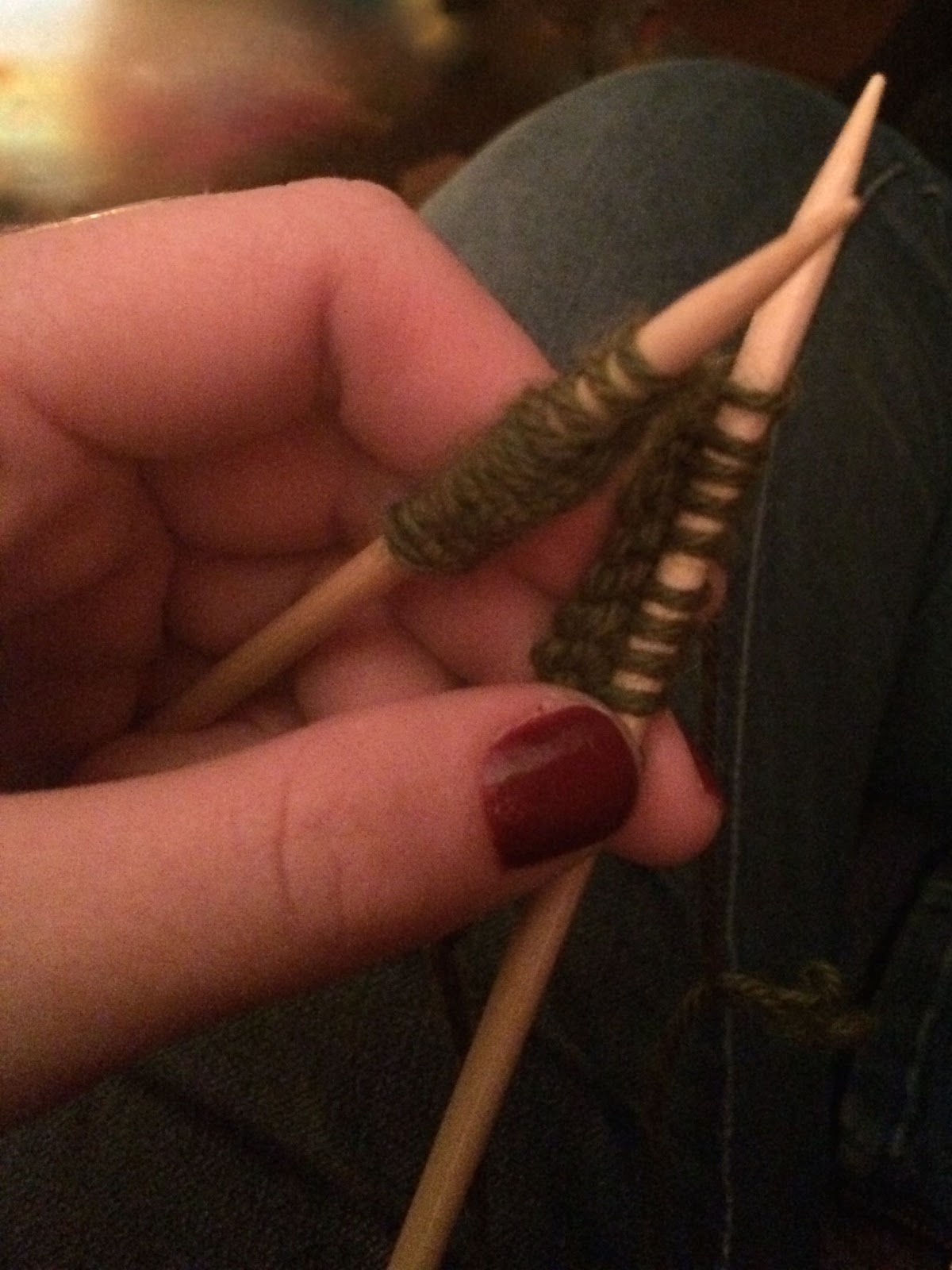
Here are my first few stitches!


Stick with the sticks (a.k.a. needles) for a couple of weeks and you may find, like I did, that from such complexity comes simplicity. Knitting is a pattern-art; once you learn to see the patterns, the craft is enjoyable. A purl stitch is essentially the complement of a knit stitch. Also, the movement is repetitive, which enables rhythmic like movement to emerge from engagement in the craft.


For my first project, a simple scarf, I picked up some forest green wool at Yarns Unlimited, a local fiber arts shop. I chose the color after speaking with a woman working in the store who told me to stay aware from light colors for now. “It will be too difficult for you to see your stitches,” she said. I also picked up a copy of The All New Teach Yourself To Knit book by Evie Rosen. Although the book contains an excellent collection of detailed illustrations, I found that the visualization of 2-dimensional illustrations into 3-dimensional space was an exercise in mental spatial rotation.

I am finding that knitting is more complicated than I ever really thought. In fact, I had never given the intricacies of patterns much thought, but now, everywhere I go I see knits and wonder how they were made.


So what’s math got to do with it? I will keep you in the loop...

Monday, January 26, 2015

Kate Samson - Embedded Knitter


Hello World. 

There is a new girl on the knitting block...that girl is me.

I’m Kate.


I am a problem solver, a people watcher, a curious cat.

More formally, I am a senior at Indiana University in Bloomington. I study Cognitive Science and Philosophy (yet it seems that the more I learn the less I know). I am interested in ideas of embodied cognition; I like to think about the way people think about thinking.

A winding route of email correspondences led me (digitally) out west and back home when I wrote to Mike Eisenberg, a professor of computer science in Boulder, CO. I wanted to know more about his work with e-textiles. I wanted to make things! He wrote a response, in which he answered my questions, and then suggested that I talk with Kylie Peppler - faculty at IU.

I quickly searched for Kylie’s work and learned that she was engaged in research involving crafts, math, and learning sciences. “This stuff is awesome!” I remember thinking as I looked through through her papers. I wrote to Kylie and, rather serendipitously, it so happened that she was looking to grow the branches of her newest research endeavor.

The project is called Re-Crafting Mathematics. I currently wear the “embedded knitter” hat, which means that it is my mission to quite literally “embed” myself into the knitting community. In doing so, I will help to develop a detailed ethnography of women’s crafting circles in the Bloomington area. So far, my debut in the fiber arts world has been as bit, erm…knotty, as learning to knit is certainly not a piece of cake. However, I am learning, bit-by-bit, stitch-by-stitch, that the joy of making is addictive.

Wednesday, January 14, 2015

Introducing Margaret Wertheim as a Member of the Re-crafting Team

Hello to everyone following this blog. I'm Margaret Wertheim and I'm thrilled to be part of the team for the Re-Crafting Mathematics Education project, an endeavor that has far-reaching consequences for how we see, understand, conceive of, and practice mathematics.

By way of introducing myself, I'll begin by saying that I am the creator - with my twin sister Christine Wertheim - of the Crochet Coral Reef project which some of you may know about. The Crochet Reef is now the largest participatory science and art project in the world and has been going for almost a decade. During that time, almost 8000 women (plus a few men) in more than a dozen countries have been collectively engaged in making gorgeous, and often giant sculptural installations of coral reefs using the craft of crochet.

Crochet Coral Reef - Green and Purple Garden curated by Margaret and Christine Wertheim for the Institute For Figuring,
featuring hyperbolic sea-slug by Marianne Midelburg and branched coral tree by Fiona Giles.

The Reef project has its roots simultaneously in craft, science, art and mathematics. All the frilly, crenellated forms that you see in coral reefs - in corals, kelps, sponges, and nudibranchs - are biological manifestations of what is known as hyperbolic geometry, an alternative to the Euclidean geometry we learn about in school. Although nature has been making such structures for hundreds of million years, human mathematicians only discovered hyperbolic forms in the 19th century after they'd spent hundreds of years trying to prove it was impossible. Yet while brainless corals effortlessly build hyperbolic forms out of minerals they filter out of sea-water, it's incredibly difficult for humans to make models of these shapes. It turns out that the best way to do it is with crochet. So the reason we are crocheting a coral reef is that its the logically necessary medium to use if you want to emulate what nature itself is doing. And one of the miracles here is that tiny ancient organisms in some sense understand profound mathematical truths - they literally do mathematics in the fibers of their being.

During the course of the Re-Crafting Mathematics project, one of the things we'll be exploring is how math is also realized in the fibers of feminine craft practice. I'll have lots  more to say on this subject over the coming months. In the meantime, I am honored to announce here - for the first time publicly - that a gorgeous comprehensive book about the Crochet Coral Reef project that Christine and I have been working on for the past year is finally finished and printed and its on the way to the publisher now. The book contains chapters on the science, the art and the environmental issues behind the Reef project, plus one on hyperbolic geometry and the discovery of hyperbolic crochet by mathematician Daina Taimina. Packed full of stunning photos of the many crochet reefs that have been made around the world, the book also contains a specially-designed section that lists all the 7000+ women who have contributed their handicraft skills to this unique, collective art+science+mathematics happening. If you'd like to order a copy of this lavish, limited-edition volume, you can do so here. The book is published by the Institute For Figuring, an organization Christine and I founded whose mission is to "promote the aesthetic and poetic dimensions of science and mathematics."

Cover of Crochet Coral Reef book by Margaret and Christine Wertheim, published by the Institute For Figuring, 2015.

In addition to being the co-creator of the Crochet Coral Reef project, I have also had a long career as a pioneer in communicating science and mathematics to women. My first book, "Pythagoras' Trousers", is a cultural history of physics which also explores how women were systematically excluded from this field for 2000 years. Throughout my career as a science writer, broadcaster, and exhibition curator, I have strived to find innovative ways to engage women in science and mathematics. I look forward to being part of the Re-Crafting Math Education team and extend my admiration and congratulations to Kylie and Melissa for pulling off this truly ground-breaking grant.

Monday, January 5, 2015

Greetings and Welcome from the Re-Crafting Mathematics Team!

We are delighted to announce the opening of our new blog for our Re-Crafting Education project team! Just recently, we received support from the National Science Foundation (#1420303) for our collaborative project titled, "Re-Crafting Mathematics Education: Designing Tangible Manipulatives Rooted in Traditional Female Crafts". This work is based on our prior work studying design, mathematics, and traditional female crafts, particularly when integrated with electronics in what we call "e-textiles."

As part of this new project, we plan to extend this earlier work to better understand how traditional female crafting practices can make far-reaching improvements in a range of learning outcomes in science, technology, engineering, and mathematics (STEM) education. These types of investigations will help reveal key issues underlying the underrepresentation of women and girls in lifelong STEM learning.

As part of our efforts, we will be conducting a series of ethnographies of female crafting circles to better theorize the connections particularly between mathematics and traditional women’s crafts. In fact, we are coming to understand craft as a lived mathematical practice -- that craft and mathematics are closely intertwined. Following our initial ethnographic field work, we're planning to develop and test a set of new hands-on classroom manipulatives for schools and after-school programs (targeted at youth in grades 5-9).

We’ve been hard at work for the past few months, launching our fieldwork, designing new large-scale surveys that we have piloted at the World Maker Faire in NYC, and joining new online communities (like Ravelry) that can teach us a thing or two about how adult crafters engage in mathematics both their in highly networked world and in their work settings. As we start to analyze our data and reflect on what we’ve learned, we’d like to share our work in progress in hopes that we might invite engagement and formative feedback from a broader community of researchers, designers, educators, and learners.

We have a fantastic team of researchers who will be been engaged in a diverse range of crafting, including knitting, quilting, crochet, and more. This team includes renowned writer and celebrated TED Talk speaker, Margaret Wertheim, who will be a key consultant on the project, as well as our excellent advisory board for the project, including Margaret Cagle, Michael Eisenberg, Rogers Hall, Paula Hooper, and Catherine McTamaney, whom collectively have expertise in mathematics education, ethnomathematics, crafting, and learning.

What’s particularly exciting to us about this project is that it represents an interdisciplinary collaboration between two learning scientists, one that studies mathematics (Dr. Melissa Gresalfi, PI) and one that studies the arts and crafts (Dr. Kylie Peppler, PI), and includes a team of scholars who come from diverse backgrounds. We have a starting team from cognitive science (Kate Samson), education (Janis Watson), and learning sciences (Sophia Bender, Kate Chapman, and Panchompoo Wisittanawat). Over the course of the coming year, we’ll be launching some new field sites and have new team members joining the mix, so please stay tuned!

As we move forward in sharing our emerging stories from the field, we'll be highlighting compelling examples and notable figures from the field. We hope you enjoy these glimpses into our fieldwork and emerging analysis as much as we’ve enjoyed engaging with these communities of activated learners, crafters, and mathematicians.

Stay tuned for more updates on relevant happenings and early reports from the field!
Kylie and Melissa