Monday, June 1, 2015

Hollis Architzel: Lunchtime Knitting

Hollis Architzel, a special educator and private tutor with My Learning Springboard, wrote this blogpost, in which she explains how she used knitting to spark interest in mathematics among her students.

In the article, Architzel writes about her concern for mathematics understanding among her students. She describes how she chose to foster a lunchtime knitting club in order to explain number-related concepts in “a different way” and that eventually the group was “able to use knitting as a platform to explore more difficult word problems.” These observations reflect the potential some teachers have already found in knitting as a vehicle for communication of mathematical thought.


By Hollis Architzel

Originally Posted April 15, 2012


math-knitting


"As a teacher, what do you do when your students don’t understand something? You explain it in a different way. When I realized several of my students were having trouble with math, I began looking for ways to explain things differently. My background is in Special Education, and one of the first strategies we learned was incorporating hands-on activities into learning. Using this as my guide, I began to explore various hands-on methods to include in my math instruction.


While the initial results were promising, I still had students struggling. One of the biggest obstacles was student frustration. Many students, after years of failure and frustration in math, had completely shut down. This obviously made it difficult for them to learn. My challenge, then, was to find a way to reconnect students to math, help them experience success, and get them moving in the right direction.


The answer I came up with was knitting. I have been an avid knitter for more than ten years and I always thought it would be fun to be able to share this skill with my students. What I didn’t realize was how useful knitting could be in teaching math. I organized a lunchtime knitting club that met every Friday. About twenty of my students signed up and I split them into two groups so I could give each student more individual attention. The first few sessions were mostly devoted to teaching the kids how to knit. After everyone had mastered the basic knit stitch, the math fun began!


First, we focused on computational skills, like adding and multiplying. We worked out real life problems like, “If I cast on 30 stitches and knit 6 rows, how many stitches did I knit?” The students would draw a picture, use numbers, or actually knit the stitches to find the answer. I also brought in some of the more complicated knitting projects I was working on. We used these patterns to transition from acting out a math problem to being able to solve it using numerical representations. The kids had a lot of motivation to practice using numbers, even if it was difficult, because they wanted to know how many stitches I had completed, and it took too long to actually count 216 x 35 stitches.


Eventually, we were able to use knitting as a platform to explore more difficult word problems. I would ask a student, “How long do you want your scarf to be?” The student would decide and then we would develop a word problem such as, “If you want your scarf to be 20 inches long and each row is .25 of an inch, how many rows do you need to knit?” Students were able to solve the word problems using drawings, models, and numbers. Then they got to knit the answer!

Lunchtime knitting was a great way to maintain student motivation and connect my students to math in a creative way."

Tuesday, May 5, 2015

Finding Meaning in Pieces We Make

“That’s a great scarf!” shouted the tall man who walked by me as I hurried home from class.


“Thanks!” I yelled back, gleefully. “I made it myself!”


As I continued to walk, I was tempted to turn back and tell him that the scarf was the first knitted project I had ever completed, and to share details about the number of times I had to practice casting on. I wanted to talk about how my first attempt had failed, and how after many more trials, I finally had this soft, beautiful collection of knots to wear. Lastly, I wanted to say “Yes, I know this is a cool scarf, I made it so!”...


Of course, by the time I had walked through all of those thoughts, he was gone.


The important point is that this experience allowed me to realize how attached to my scarf I had become.


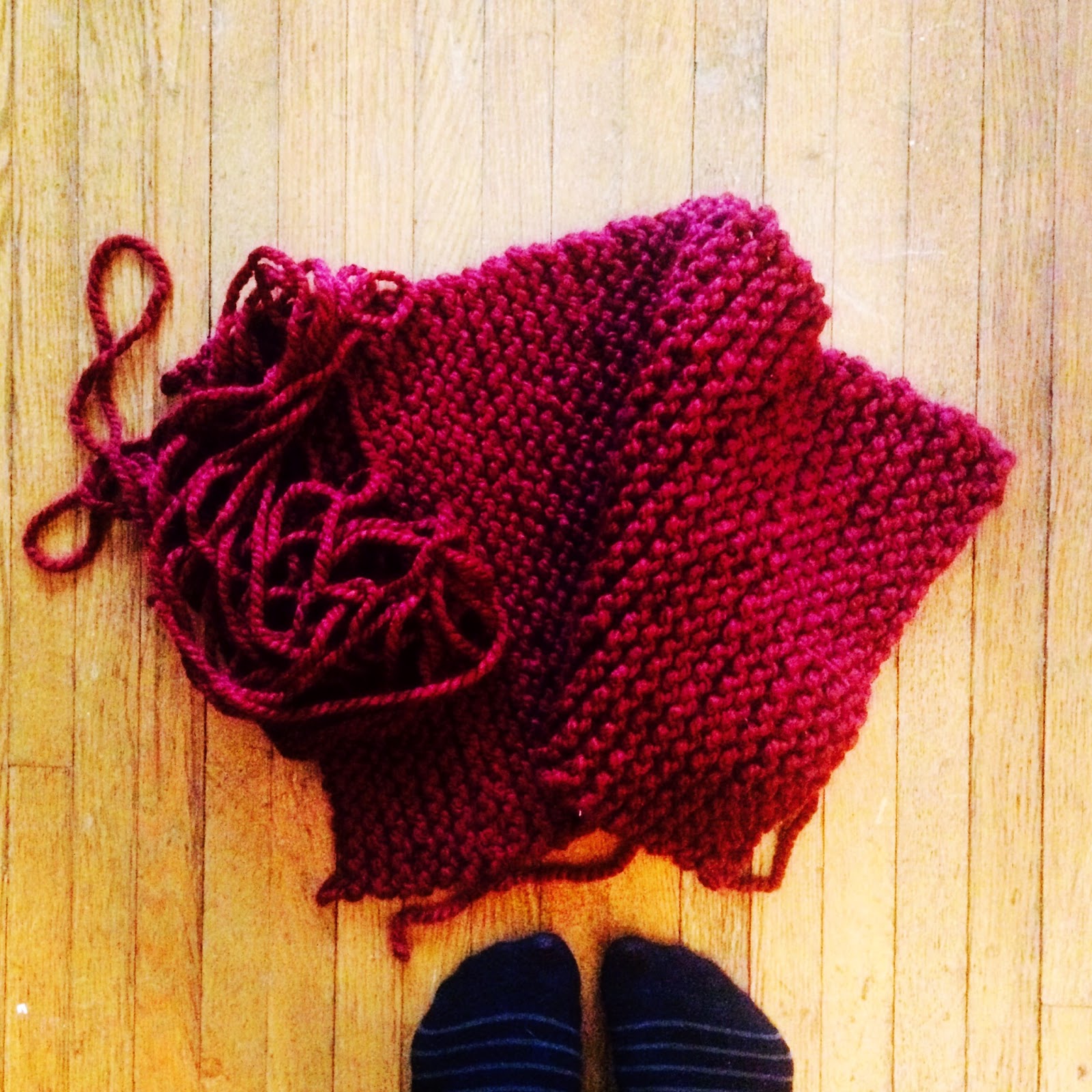
At one point in time, the scarf I was wearing had been a mere mess of yarn (see previous blog posts), knitted and tinked to yield a seemingly useless square of berry-colored material.  


IMG_0022.jpg


After many weeks of attending knitting workshops and talking with experienced fiber artists, I got the hang of the knits and purls, and began to see the patterns emerging in my knitting. This first project, a scarf made of all knits (garter stitch) was simple enough for me to work through, but still allowed plenty of room for error. I lost count of my stitches several times, and at one point, forgot what the finished product was supposed to look like. Eventually, it was brought to my attention that the completed piece could look however I wanted it to look - after all, I was the maker.


IMG_0023.jpg

I am proud of the fact that I can now make wearable pieces. Further, it is clear that I have attached meaning to this item I made; there seems to be something particularly special about wearing a piece that I made by myself for myself. I would predict that many other makers can relate to the notion of creating meaning through making.


There is something profoundly meaningful in acknowledging the freedom to design and create a wearable textile. Over time (and stitches) I have come to develop a sense of empowerment in completing knitted projects. The anecdote at the beginning of this post communicates the willingness I had to share my process of making with a stranger.


The completion of a project teaches the novice knitter that it can often take a much greater amount of time to knit through a pattern than initially anticipated. There are new stitches to learn, errors to fix, and sometimes (painfully) entire rows to rip out. By the time the knitter reaches the end of a pattern, much has been gained: The individual has a new piece to wear, fine motor skills have been strengthened, and often, new techniques have been acquired.

I have observed a trend in behavior across makers to willingly talk about the process of making. It seems that the creative process involved in making seems to bolster, and sometimes even outweigh, the value of a finished product.

Thursday, April 30, 2015

DML Commons - Upcoming Opportunities!

DML Commons provides an online scholarly community for makers and crafters. Two distinct course options - Design Research and other Professional Pathways - offer creative opportunities in both professional and academic domains. Through DML Commons, individuals are able to be virtually present in dynamic conversations of various elements of design research and design activities.


The Design Research course is focused on elements of design-based research. Four categories have been created to communicate key components of this research method. In this course, senior scholars share details of experience, while junior scholars are encouraged to pose questions and discuss interests.


The Professional Pathways course option is comprised of 4 units. Each unit is made up of two rich and informative 60-minute online conversations about a particular topic, such as academic writing and publishing, which are lead by junior and senior scholars. The conversations are recorded and can be revisited later on.


It is a great time to get involved in the design conversation - courses are happening now!

Sunday, April 26, 2015

Reflections on Sewing Machines

Every time before March 26 when I used a sewing machine, I was always surrounded by others who knew how to use them. They had helped me to set up the machine and troubleshoot problems, so with their support, I managed to sew a few small projects successfully (for my Sailor Moon outfit, I only sewed the collar on a machine. A friend from Discardia sewed the skirt. The rest was either hand-sewn or purchased). This was the first time I had ever tried to use one on my own. And… it was one of the most frustrating experiences of my life! But even though I was “alone,” I ended up using many community resources after all, because successful sewing is impossible without them. More info after the break!


Saturday, April 18, 2015

Knitting Escher Patterns

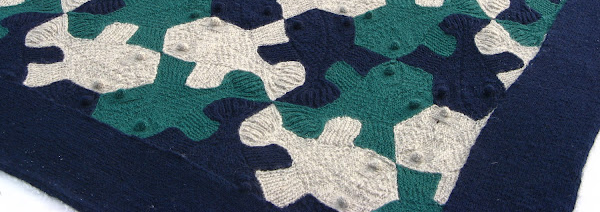
Check out The Aperiodical - a virtual meeting-place for people who already know they like maths and would like to know more - for tips on how to recreate M. C. Escher patterns in knitted textiles. I think this caliber of project may be a bit beyond my skill level, but perhaps one day I will give this a try!  


Written by Katie Steckles
Originally posted September 4, 2012 in Arty Maths

"Following on from our maths/knitting post earlier this month, we’ve found a knitting blog full of knitted MC Escher designs. The famously mathematical graphic artist MC Escher was king of tessellating designs with repeated fish, birds and other animals.


Jana, who writes the blog in question, has taken on the formidable challenge of creating knitting patterns for a variety of different Escher designs and not without a deal of success. The designs are all hand-knitted and are ridiculously intricate: while some are made from separate shapes stitched together, there are some which are knit in rows with two colours, using a pattern of her own design. Much maths and knitting respect is due.


All posts on her site tagged with ‘Escher’ can be found here;  particularly noteworthy are a blanket with a fish design, and some beautiful cushions.


(via Rudy Rucker and Edmund Harris on Twitter)"

A Magical Transformation: My Sailor Moon Cosplay Story

When I was a kid, Sailor Moon was my favorite TV show. It tells the story of an ordinary teenage girl who can transform into a sailor-suited superheroine called Sailor Moon. Later she’s joined by a team of her friends, and together, these superheroines use magic to fight evil. This series holds a lot of nostalgia for me because it was my first foray into Japanese anime (now one of my favorite forms of media), my first motivation for developing internet literacy as I surfed around for Sailor Moon-related fan sites online, my first experience with reading and writing fan fiction, not to mention the first story I’d ever heard of that featured a whole group of female, rather than male, superheroes! Last year the series also got a reboot in the form of a whole new anime, so it remains current and popular. It thus seemed only appropriate that I chose Sailor Moon as my first cosplay.
When I first found out I was going to the Wizard World Indianapolis Comic Con (my first fan convention ever!), I had less than a week to finish my Sailor Moon cosplay. Not to worry; last-minute costume creation is a time-honored cosplay tradition!

In the process of completing and wearing my first cosplay costume, I learned a great deal about the math involved in sewing, the identity play involved in taking on a character’s appearance, and the resources distributed throughout both digital and in-person communities that make success in cosplay and sewing possible.

More on my first cosplay experience after the break!

Sunday, April 5, 2015

Announcing the DML Commons Connected Courses! Get involved!

We here at the Creativity Labs have been collaborating with folks from the DML Hub to design the DML Commons (http://dmlcommons.net/) – see info below. We are excited to announce that the DML Commons are officially kicking off this week! Now is a great time to get caught up before the first units start!

DML Commons is an new open online course that is designed for graduate students, postdocs, junior scholars, and early career professors figuring out a professional pathway and/or delving into design-based research. We are hoping to unearth the kinds of stuff that graduate school does not commonly explicitly teach!

There are many ways to get involved, e.g., by joining all units, joining one unit, blogging, tweeting etc. The best way to get started would be to set up a blog and to connect it to the DML Commons >> http://dmlcommons.net/connect/

We are looking forward to an exciting few months ahead. We would love to have people from all across the world join the fun! Come join and invite your friends to participate too!

This coming week, the Design-Based Research strand will kick off with "Purposes/Argumentative Grammar of DBR", and the Professional Pathways will get started with live events on "How to Fund, Launch, and Collaborate on a Research Project"!

Looking forward to seeing you online! More info can be found in the press release after the break below.