Monday, February 22, 2016

Introducing Fabric Manipulations!

Connected Learning while Re-Crafting Math

* Originally posted in Anna's Constructionism, February 22nd


After long days at the school, I like to browse Pinterest for fun craft projects and to get inspired about what I could make if only I had more time. Perhaps an indicator for having a healthy attitude towards the future, the many pins and re-pins on the pictures in the app tell me that there are probably many people like me out there. A resource to tap into were I to commit.

I am a graduate research assistant at the Creativity Labs, where we strive to design for powerful ideas keeping in mind tools and materials for more equitable learning environments. One of the projects I had the chance to work on is the Re-Crafting Math project, which explores the implicit and explicit mathematics and STEM related concepts tangled into traditional female fiber arts practices. We are exploring this through embedded ethnography, e.g., joining a crafting group and learning along with its members, and interviews of experienced crafters. In the office, there is usually someone talking about the complexities of knitting, sewing, crocheting, or weaving at some point every day. Fiber, threads, fabric, needles, and pins have become an important part of our academic and professional culture. 

To really get going on the Re-Crafting project, I had to find my own fiber craft. Initially stretching it towards the harvesting of fiber for basket making, a craft in which I experienced a strong pushback between crafter and material, I settled on fabric manipulation. Fabric manipulation is the craft of folding, sewing, assembling, and pulling fabric into three dimensional and layered shapes (see pictures above). A sub-category of fabric manipulation is origami quilting, in which the crafter folds fabric similarly to paper origami and sews the folds on to batting, the insulating material, and backing material. 

By diving into this craft, I could combine my interests in lines, folds, and clear cuts with my interest to start a particular craft that could contribute to the project. It is at the intersection of these three areas, (1) the interests, (2) academic, and (3) peer culture, where Connected Learning is theorized to happen. Addressing divides between in-school and out-of-school learning, income equity, and generation, Connected Learning is ties together production-centered, openly networked, purposeful creativity with interest and peer driven learning. Sharing productions and insights with local communities as well as with the broader public is an important locus of Connected Learning. Learning outcomes relate to individuals as well as to the collective or society. (Ito et al., 2013)

While personal interests, academic/professional culture, and peer learning seem come together in my fabric manipulation journey, I wondered what, if not all, could be considered Connected Learning?

When I found the Fabric Manipulation pictures on Pinterest, I was surprised by the versatility of fabric and the beauty of the shapes people had created. At first glance, one can imagine how the techniques could be embedded in fashion or quilting projects. Undecided how to move forward in relation to a larger contextual frame, I decided to explore some of the techniques by following tutorials that Pinterest linked to.
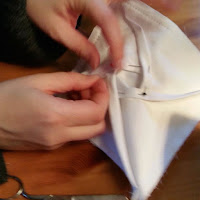

The windy, rainy days of winter break 2015/2016 were my chance to get started. Having had dreadful memories of breaking the machine in the past, I was lucky to get started at home in Germany where my mother, once again, could teach me to use the sewing machine. Together, we converted the inches into centimeters and got set up after ironing a pillow cover that used to belong to my grandmother and cutting it into pieces. With the smell of steamed old linen in the air we got started sewing. It felt great to engage in this intergenerational experience through a tangible and production-centered project that could be useful for my academic work as well.


Most of the complex mathematical thinking happened during preparation and sewing the projects. For example, we discovered that many of the techniques were not straight forward and problems needed to be recognized and set up first. This was especially true for the projects that involved tucks, because the overall fabric size needed to be calculated in relation to tuck size and final project size. Implicitly understanding those mathematics concepts that could be written into equations, we often moved forward by inventing short-cuts. For example, to center the tucks we folded the fabric rather than calculating and measuring distances.
Smocking mathematics in Puerto Rico
After leaving Germany, I continued my crafting during a pit-stop at the San Juan beach and later at home in Bloomington. When I paused to actively think about the mathematics concepts involved in the different fabric manipulation projects involved, the list kept growing, including basics, such as addition, multiplication, and measuring to more challenging mathematics, such as coordinate geometry, trigonometry, and quadratic functions. I noticed that when showing my projects to people, I traced lines, folds, and curves at specific parts of the project to point out mathematical concepts and mistakes I made when calculating or short-cutting the projects. I started calling my fabric manipulations mathematical proofs, and started to explore the tactile and auditory interactions of the spatial manipulations.


Thinking about how to bring Fabric Manipulation to the classrooms, many ideas came to mine, mostly cycling around a gallery walk that displayed my mathematical proofs, unicolored as they are, as suggestions to move forward. It was only after I met with the former president of the local Quilters' Guild that the idea of an instructional book was tossed around. We imagined the actual fabric projects being pasted on one side with the mathematics concepts listed on the other – the viewer could to literally grasp the mathematics. We also came up with a few  example projects that could be illustrated to present the versatility of individual techniques. These examples could reach from using different colored fabrics to useful projects such as ornamented pillows or bags. 

The connected journey, stretching across international waters, generations, and academic, professional, and peer cultures is a continuously growing learning experience. With each step new possibilities emerge with decisions awaiting to be made. Following my interests in the production of projects and the types of connections I make is my campus along the way. As I continue to explore these project examples, I am excited to discover new pathways into STEM learning together with other crafters. Next stop, the Indiana Heritage Quilt Show!

References
Ito, M., GutiĆ©rrez, K., Livingstone, S., Penuel, B., Rhodes, J., Salen, K., Schor, J., Sefton-Green, J., & Watkins, S. C. (2013). Connected learning: An agenda for research and design. Digital Media and Learning Research Hub.

Sunday, February 21, 2016

How do I cast on? Let me count the ways.

Think back to the time you learned to knit. Who struggled with the cast on? 
(Everyone can raise a hand now.)

The cast on can be difficult for beginner knitters. 


The cast on is tough: Make a loop on one needle. And slip it onto the opposing needle without dropping anything or messing anything up. And don’t pull the loops too tight. And don’t knit too close to the point of your needle. Remember to breathe. And...stop frowning. Got it?


Although the cast on can be tricky, it does yield a lot of opportunity for customization. The knitter gets to choose what type of cast on to use. Lots of seasoned knitters have a favorite cast on or preferred style. A particular type of scarf may be better with a strong cast on, such as the longtail. A cabling piece needs a cable cast on. Check out this article for some clearly-explained details. (Somewhere, I imagine there must be an article with a title like “What your favorite cast on says about you.”)

I became curious about cast-on techniques when a knitter I recently talked to told me that she had a favorite cast on practice. I always cast on using the same technique and had not thought about the differences a cast on could make in the finished piece.
Different cast on methods can lead to stylistic variation. What's your favorite?


So how about the math?


Sometimes, knitters talk about the math involved in the cast on. For example, consider one knitter who has a true love for the long tail method. She talks about these ideas in  The Mathematics of Long Tail Cast On. One commonly accepted rule of casting on is to make a tail that is the three times the width of the knitting and add a few inches.


Saturday, February 13, 2016

Math for Knitters

Every now and then we feature mathematical connections on this blog (we are, after all, trying to recraft mathematics education). Although we investigate the potential computational links in detail, we are not the only ones! In fact, many others see the underlying and inherent mathematics of crafts too.


Math for Knitters identifies and clarifies the function of mathematics in knitting. 

Recently, I came across the Very Pink Math for Knitters web page, which stays true to its title. What’s better? Each concept has an affiliated video embedded in the website, which helps to clarify the sneaky little bit of math that slips into your sweater or hat when you’re not thinking about it.  

Staci Perry, a knitter and knitting teacher in Austin, Texas, runs the Very Pink. Have a listen to what she has to say:


Have you thought about the way you rely on math in your cast on? Watch this video and I bet you will from now on!

How ‘bout increases and decreases? Can you see where the math comes in?

When it comes to knitting, math is a friend to all.

Sunday, February 7, 2016

You Haven't Lived Until You've Cosplayed with a Group!

I figured it out, everyone! I figured out how to feel comfortable, as a woman, with cosplaying a male character!

First, it helps to be able to cover up your feminine face with a mask:

I bet Kylo Ren, too, found that his mask helped him to forget who he truly was and pretend to be someone else.
Second, let the character live in your head for a few weeks leading up to the con. And Kylo Ren (from the latest Star Wars movie) did. I found him compelling because his fate is so uncertain; will he return to the light side? Will he (Force forbid) die? The other new main characters are all going to be fine. I don't need to worry about the state of their souls. But with Kylo Ren, I spent the weeks since I saw the movie feverishly trying to figure out a way for him to get his redemption. I do this with characters a lot! That's why so many of my favorites are similar to each other (Itachi, Dirk, and Zuko all follow this pattern too).

Third, be willing to make fun of the character. The internet has had a field day making fun of Kylo Ren for his whiny tantrums (e.g., the Emo Kylo Ren twitter account). While I take the possibility of his redemption seriously, I'm not averse to having a bit of fun at his expense. He deserves it! And this also gave me fodder for jokes I could throw around all day at the con while cosplaying him.


Kylo Ren does NOT appreciate being left out of photos!

Perhaps most importantly, though, it's good to surround yourself with a group of friends also cosplaying from the same series, so you can play off each other the way the characters would.


I can't remember the last time I had this much fun! The four of us were staying in a hotel room together at Ohayocon in Columbus, OH last month, and on Saturday of the con, we decided to all dress up as characters from the new Star Wars movie. This was a bit of a last-minute decision; as such, this is the first costume I've worn that I did not make myself. Steph, an experienced cosplayer (the one cosplaying Poe), threw the costumes together from among items she had lying around her house after ten years of cosplaying. What I lost in not making the costume, though, I more than made up for in fun with friends. Since this is such a popular franchise right now, we couldn't go two steps at the con without someone stopping our group to ask for pictures. The positive attention was really nice! We also staged our own photos, recreating scenes from the movie, or scenes (usually of a...romantic nature) that we imagined ourselves. While we weren't in character 100% of the time, we did throw banter back and forth all day related to the characters.

Surrounded by this milieu, I had no trouble acting like this male character. I exaggerated his whiniest, most emo traits. I gleefully pursued all the Han Solo cosplayers I could find in order to recreate that iconic, heartbreaking scene with him. I chased after a Darth Vader cosplayer, because Kylo Ren is a total Darth Vader fanboy. I got scolded by a Leia cosplayer. I even wrote my Facebook comments in character! For instance, when a friend saw a photo of all four of us, she asked, "Are you Kylo? Love love love!" I responded, in typical wannabe-Sith fashion, "Love is for the weak. -Emo Kylo Ren."

After this experience with a group, going back to cosplaying by myself is going to be a bit of a letdown! I think this shows how, once again, the community aspects of cosplay are so important. It's not just that community provides a context for cosplay; it also helps individuals to gain confidence--even when they're cosplaying someone completely different from themselves.

Tuesday, February 2, 2016

Knitters in the Wild

Where are the knitters?


They are everywhere. That’s where.


They are in your city, in your parks, in your subways stations.

Have you seen a knitter in the wild?
They are your neighbors, your teachers, your relatives, your friends.


They fly on airplanes and travel in trains.*


The knitters are everywhere.


I cannot tell if it is the case that the number of knitters in America (or, at least, in Midwestern America) is increasing, or if I am simply more aware of the presence of knitters now. Over the past year, I've run into knitters in the strangest places...


Recently, I traveled to California to visit a galpal and escape the snow. As I boarded the airplane and fumbled to my seat, I came to find myself in the same row as another knitter. She had delicately set her pattern to perch on the fold out tray table connected to the back of the seat in front of her. At first I was quiet. I took out the partially-completed hat I had started for my mom. The woman in my airplane row quickly became chatty with me. This is not the first time this has happened.


Where else will I find the knitters?


More curious is the idea that knitting brings together individuals who come from such a diverse array of backgrounds. 

What draws knitters to knitting?


I have a hunch that the sense of community plays a leading role in the whole game. I'll be on the lookout for these knitter in the wild.

*Yes, TSA allows you to carry on your needles!


Knitting can calm those pre-take-off nerves. 

Saturday, January 23, 2016

Scoreboard Knit-A-Long

As Super Bowl 50 approaches and the Fantasy Football fever continues to spread, it is likely that there may be some fireside (TV-side) gatherings in your future. These get-togethers provide a space for food, chitchat, snuggles, and - you guessed it - knitting!

Personally, I am not much of an American football-watcher. I like athletics and can see why people like to play the game, but the allure of American football has always been a bit of a mystery to me. The run-stop-run-stop-run-stop-throw flag-run-stop series of events and big men in tight pants do not pique my interest in the way a jigsaw puzzle might...

Ok, this is not the point. 

The point: Knitting culture has a way of sneaking into the corners and cracks of seemingly unrelated communities. 


The Scoreboard Knit-A-Long was designed by Michelle Hunter, an author, teacher, and designer.

To make the Scoreboard KAL, the knitter works with two or three colors of a favorite football team. The main color in this piece represents the points earned by the knitter's favorite team, whereas the secondary color represents the points scored by any opponents of the favorite team. A third color, such as a white line, can be worked in to the project to allow for a break between games. Then finish piece is a Scoreboard Cowl. PRETTY COOL, AY?


The Scoreboard Cowl can be knitted with two or three yarn colors. 


I found out about this KAL from another knitter in Pittsburgh. This is the Steel City,  after all, and people are totally crazy really excited about sports.

Knit projects, such as the Scoreboard KAL, speak to the culture and community involved in the fiber arts. Knitting is not an untouchable or reserved hobby, only meant for yarn shops, Tupperware parties, or women. No. Knitting is a ubiquitous craft form; knit-purls are for art communities and sports communities. Like I mentioned earlier, the point of this post is to shed light on the beautiful way that the culture of knitting can become part of any community, much like a warm and comfy, one-size-fits-all sweater. 


Saturday, January 2, 2016

The Danger of Shortcuts!

In my last post, I hinted that my next cosplay would be a fiery version of Elsa from Frozen, combined with Zuko from Avatar: The Last Airbender. This translates to a dark-haired Elsa dressed in fire colors, with Zuko's scar and Fire Nation accessories. I ran out of time before the con, however, and didn't get a chance to add Zuko's accessories to the red Elsa dress. So I went as simply a Fire Elsa this time around (the Zuko parts will be ready in time for my next con, though!).

A fan artist's rendition of a Fire Elsa
(source: http://messr-snuffles.deviantart.com/art/Elsa-Fire-Version-524584491)

Months ago, I found a pattern for an Elsa-like dress at JoAnn Fabrics, since she's such a popular character. I thought making this costume would be time-consuming, since it's so elaborate, but not difficult, since all I'd have to do was follow the pattern. I also thought the pattern would reduce the need to use much math during the process.

How very wrong I was.

This was my first time using a commercial pattern, but it was definitely not beginner level. If I had been following a typical path in learning sewing, I never would have used this as my first pattern. But cosplay goals tend to motivate cosplayers to sew projects more difficult than their supposed "skill level" would call for. I started this over Thanksgiving break, working in my parents' dining room, and I needed to finish before the Con-Alt-Delete anime convention on Dec. 18-20, while also being in the midst of end-of-semester finals. I didn't have time to practice with easier patterns!

Commercial sewing patterns come in envelopes containing the pattern pieces on thin tissue paper and folded instruction sheets. Often they contain more than one outfit. This one had Anna's outfit as well as Elsa's dress, in both adult and child sizes. The pattern pieces had marks corresponding to sizes S-XL, and you had to select the size matching your body in order to cut all the pieces to that size. The outside of the envelope contained a body measurement chart somewhat like this one telling you what size corresponded to your body measurements. I got help from my sister to take my measurements with a flexible measuring tape, and it appeared that, according to this chart, most of my measurements were size L. I am not size L in any of the other clothes I wear, but I'd been told that pattern sizes were different from usual clothing sizes. L sounded too big, but I figured that it was better to cut things too big than too small, because I could always cut down extra fabric later.

That was my first mistake.

Me sewing the skirt that at first was 4 inches too wide!

Everything ended up too big. I started cutting things down to a size that approximately fit me when I held it up around me, but I didn't realize that you can't just modify one part of a garment made from a pattern without making the corresponding changes to all pieces that will connect to the piece you modified. And when a piece is size L, it's size L all the way around. You can't just trim off the ends.

For instance, the sleeves ended up way too big on me. I tried to trim them by getting some help from family members in holding up the sleeve piece to my arm, and trimming the ends where they met under my arm. But I failed to realize that the size L sleeve was meant for someone with much larger arms than me, all the way around. This meant the shoulder was too big for me, and the ends met below it to make the armhole much farther down than where my own underarm was. So when I trimmed the ends, because the sleeve was on a slope, the shoulder remained too big while the armhole shifted away from the body. When I tried to sew them on the dress, they pulled my too-big bodice outward in a weird way, and I couldn't lift my arms. Basically, because I had not cut them proportionally, the sleeves no longer reached all the way up to my underarms. I had no choice but to cut them off.

Yeah...the underside of that sleeve is nowhere near my armpit.

Fortunately, my artist friend Gail helped me fix the bodice with a couple of last-minute side-darts. This was the night before the con, so we had no time to fix the sleeves. I wore them as sort of gauntlets instead, like handless gloves. And honestly, the costume ultimately turned out pretty good! I have never gotten so many positive comments on a costume at a con before! That was a real confidence booster, after so many things had gone wrong with this cosplay.

Bad bathroom selfie! Hopefully I'll be able to get a better pic at the next con.
I thought I could use a premade pattern as a shortcut to make sewing easier, because there would be less measuring involved. Well, it turns out that trying to avoid the math was more of a headache than a shortcut! Taking my own measurements precisely, and comparing them to the measurements of the pattern pieces would have worked better than trying to alter after the fact. I should have also used proportional reasoning to trim too-big pieces, rather than just trimming in one place. But I have learned so much from this experience, and I know I'll be more careful the next time I use a pattern!